
Labette County Marriage Licenses
In Kansas, marriage licenses are handled through the District Court system. KDHE states that marriage information is open to the public at the county district court level, while certified marriage certificates are handled by the state Office of Vital Statistics. For Labette County, the practical local contact for marriage-license status, local public marriage information, and court-file questions is the Clerk of the District Court at the Labette County Judicial Center in Parsons.
The Kansas Judicial Branch provides the statewide online marriage-license application path. The research did not locate a Labette-specific marriage-license fee, waiting-period text, or local application-hours statement in official Labette County pages, so those details should be confirmed with the court where the application is filed. Kansas statewide practice should not be converted into a Labette County fact unless the court or state self-help source states it directly for the current application process.
The KDHE Office of Vital Statistics is the state certificate office for marriage and divorce certificates.
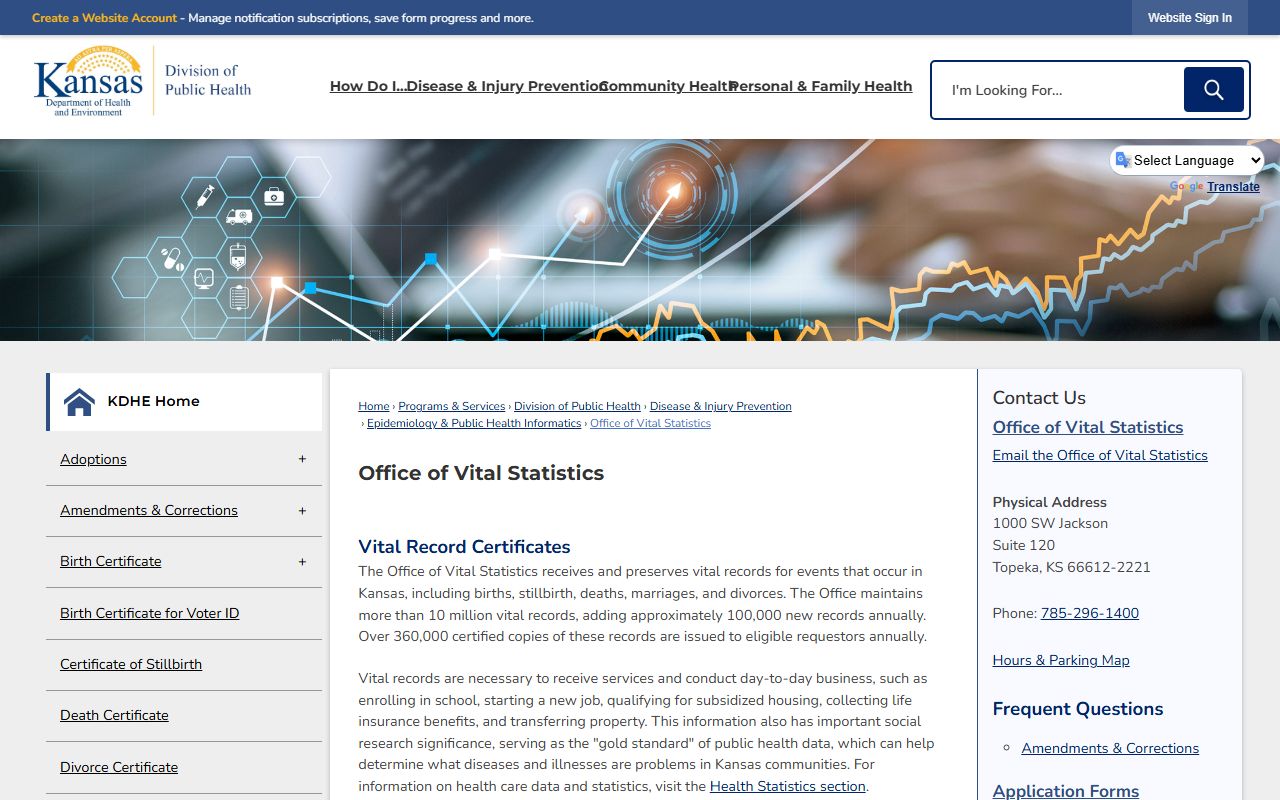
KDHE certificate access is statewide, while Labette County court questions still route through the District Court clerk.
Apply for Labette County Marriage Records
The Kansas marriage-license process starts through the state court self-help application path. Both applicants use the statewide application route, then contact the court where the application was filed for status questions. For Labette County, that court contact is the District Court clerk when the application or local record question belongs in Labette County.
- Start at the Kansas Judicial Branch marriage-license application path.
- Enter applicant information and other applicant information through the statewide court application.
- Submit the application controls shown by the Kansas court self-help system.
- Contact the court where the application was filed for status questions.
- After the marriage, use KDHE for a certified state certificate or the District Court clerk for local public marriage information.
Note: Exact Labette County marriage-license fee and waiting-period wording were not located in the official extracted sources reviewed.
Labette County Marriage Application Fields
The research captured the statewide Kansas court application at a high level, not a full field-by-field view of every screen. The important point for Labette County marriage records is that both applicants are part of the same court process, and the court where the application was filed is the status contact. Keep the application information consistent with legal identity and contact details because the license and later certificate rely on those entries.
| Field Label | Type | Required | Notes |
|---|---|---|---|
| Applicant information | web form | yes | Statewide Kansas marriage-license application. |
| Other applicant information | web form | yes | Both parties apply through the state court process. |
| Contact / status information | web form | yes | Use the court where applied for status questions. |
| Submit / application controls | button | yes | Submit through the Kansas Judicial Branch self-help link. |
Search Labette County Marriage Records
KDHE states that marriage certificates began being filed with the Kansas Office of Vital Statistics on May 1, 1913. For certified certificates after that date, KDHE is the state route. For earlier records, historical or county routes may be needed. For public marriage information at the county level, KDHE points to the county district court, which makes the Labette County Clerk of the District Court the local record contact.
The difference between a public court-level marriage record and a certified state certificate matters. A public county-level marriage inquiry can help confirm local filing facts, while a certified KDHE certificate is the state vital record used when a certified copy is required. Vital records are not public records for certified-copy purposes; KDHE limits certified copies to the person named, immediate family, legal representatives, or persons who prove a direct interest needed for personal or property rights.
The KDHE marriage certificate page states the statewide certificate start date and the county district court public-information route.
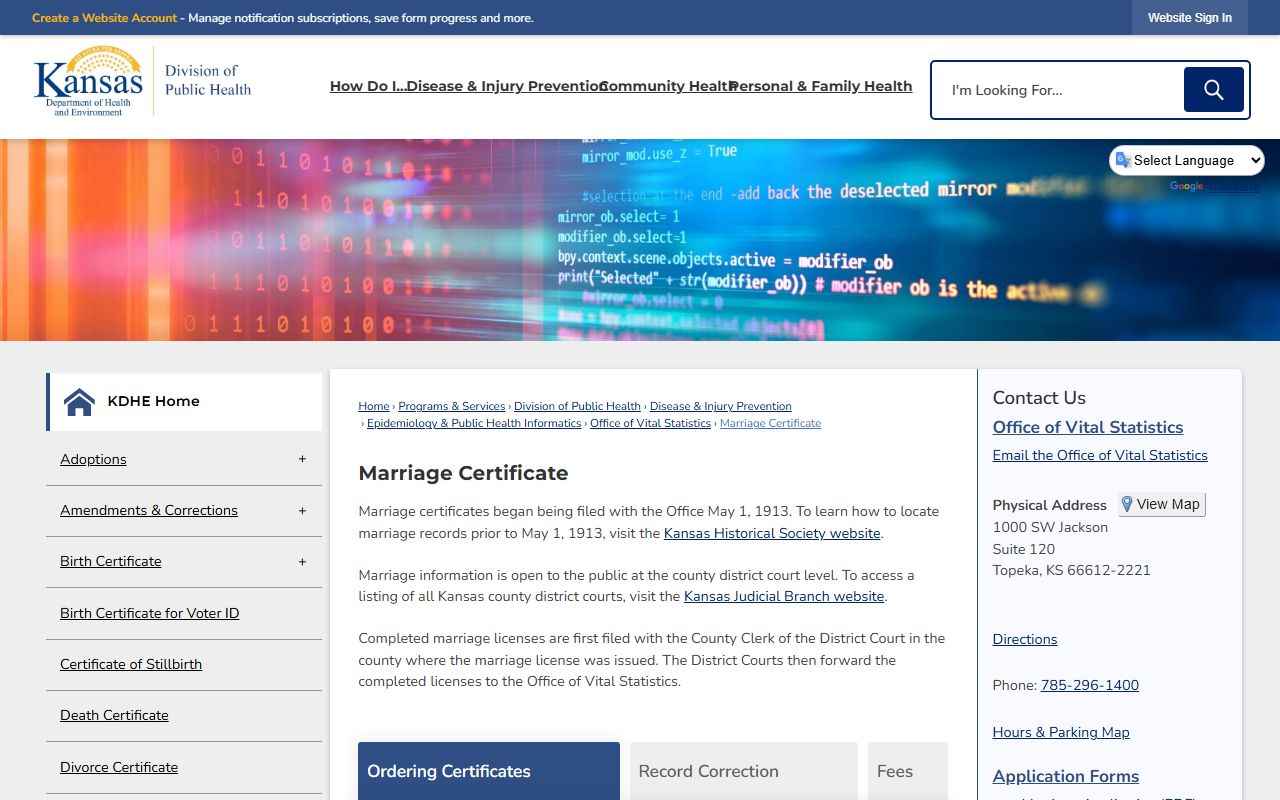
That KDHE distinction helps record seekers choose between a Labette County court inquiry and a certified Kansas marriage certificate order.
Find Labette County Divorce Records
Divorce records have the most important custodian split. KDHE says a divorce decree is not filed with KDHE. The decree is the court document detailing the divorce settlement, and certified copies of divorce decrees are obtained from the Clerk of the District Court in the county where the divorce was filed. For a Labette County divorce decree, use the Clerk of the District Court rather than the state certificate office.
KDHE issues certified divorce certificates. A certificate contains basic information such as the names of both parties, date of marriage, and date of divorce. It is not the settlement decree, does not provide the full court file, and does not replace District Court access for pleadings, orders, custody provisions, support terms, property provisions, or sealed domestic-file material.
Divorce case status may also be searched through Kansas Case Search or a courthouse terminal when the public case information is available. That search route is useful for finding the case number before asking the Labette County clerk for a decree copy. Domestic files can include protected identifiers, minor-child details, financial account information, or sealed filings, so a public case result should not be read as a promise that each document in the divorce file can be released.
- File or search the divorce case through District Court when Kansas residency and jurisdiction requirements are met.
- Use Kansas Case Search or a courthouse terminal for public case status where available.
- Request decree copies from the Labette County Clerk of the District Court.
- Order a KDHE divorce certificate only when the basic certified vital-record certificate is needed.
Labette County Marriage Divorce Fees
The researched official sources located KDHE certificate fees and channels but did not locate Labette County's local marriage-license fee, divorce filing fee, or District Court certified-decree copy fee in extracted text. A record seeker should treat those local amounts as clerk-quoted fees. KDHE certificate costs are clearer because the state divorce certificate page publishes the method, cost, and processing details.
| Item / Method | Amount / Time | Notes |
|---|---|---|
| KDHE certified marriage certificate | $20 per certified copy | State certificate route, not local court public information. |
| KDHE divorce certificate, walk-in | $20 per certified copy | 9 a.m.-4 p.m. Monday-Friday; about 15-20 minutes if no difficulty locating record. |
| KDHE divorce certificate, internet | $20 plus $15 expedited service fee | 3-5 business days after receipt in office. |
| KDHE divorce certificate, telephone | $20 plus $15 expedited service fee | 877-305-8315, 24/7/365; Spanish interpreters available. |
| KDHE divorce certificate, iKan app | $20 plus $5 processing fee | One certified copy per order; will call often same or next business day, regular mail 7-10 business days. |
| KDHE divorce certificate, mail | $20 | Regular or priority mail, usually 7-10 business days depending on request volume. |
| Labette County decree copy | Fee not located | Ask the Clerk of the District Court for current copy and certification charges. |
Certified Copies and Access Limits
Certified marriage and divorce certificates come from KDHE when the requester is eligible under vital-record rules. KDHE states that Kansas vital records are not public records for certified-copy purposes. Eligibility is limited to the person named, immediate family, legal representative, or someone who proves a direct interest necessary for personal or property rights.
Certified divorce decrees are different. A decree is a District Court document, so a Labette County decree request goes to the Clerk of the District Court in the county where the divorce was filed. The public case record may be searchable through Kansas Case Search, but domestic files can contain restricted information, sealed items, protected addresses, minor details, or financial identifiers that are not released in full.
Marriage certificate requests should use KDHE when the requester needs a state-certified vital record. Local marriage-license status questions should use the court where the application was filed. For older marriage records before the state filing date, the research points to historical and county routes rather than KDHE's modern certificate file.
Important: A KDHE divorce certificate proves the event; a Labette County divorce decree shows the court's orders.
Kansas Vital Records Office
KDHE Office of Vital Statistics maintains Kansas birth, stillbirth, death, marriage, and divorce vital records. The research notes more than 10 million records, about 100,000 added annually, and over 360,000 certified copies issued annually. This is the state certificate office, not the Labette County District Court clerk and not the custodian of divorce decrees.
KDHE Office of Vital Statistics
1000 SW Jackson, Suite 120
Topeka, KS 66612-2221
785-296-1400
Labette County Clerk of the District Court
201 S. Central Avenue
Parsons, KS 67357
620-421-4120
Use for local marriage-license status questions and divorce decree copies.
The KDHE divorce certificate page explains the certificate order methods and the decree distinction.
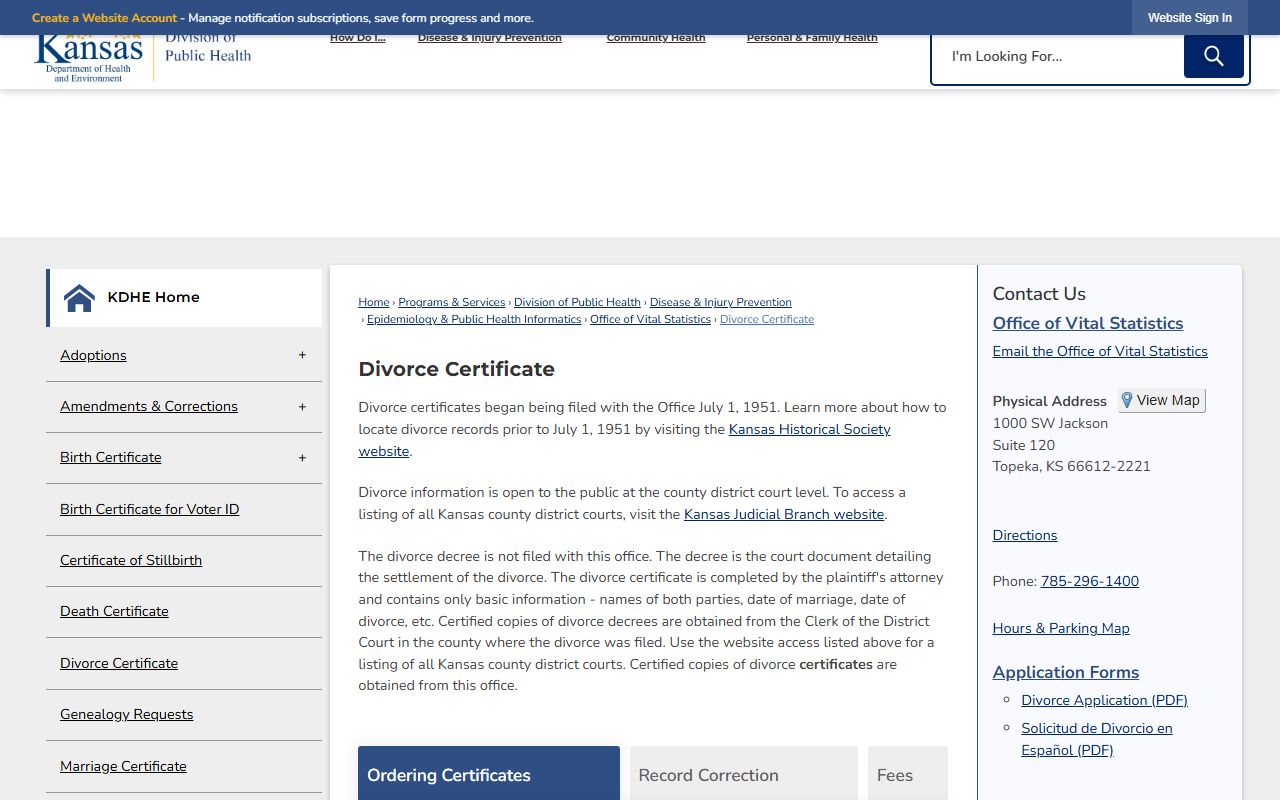
The KDHE page is the state route for divorce certificates, while the court decree remains a Labette County District Court record when the case was filed there.