
Labette County Arrest Records and Court Charges
Labette County arrest records start on the law-enforcement side. The Labette County Sheriff's Office keeps jail and records functions at 718 5th Street in Oswego, and its records office enters offense reports, accident reports, and citations into the agency database. The Sheriff's Office also forwards records information to the KBI, KDOT, insurance companies, the Labette County Attorney, and District Court when the record needs to move into a court or state reporting channel. That path matters because an arrest entry is not the same thing as a filed criminal case.
A booking or custody record may show the arresting agency, booking number, booking time, charge text, bond amount, and a case number when one is available. A court charge record begins when the County Attorney or another authorized prosecutor files a complaint, information, or other charging paper. The court record then tracks the charge through the District Court or municipal court. For custody-only details, the jail roster is the better source; for pleas, hearings, disposition, and sentence, use the Labette County criminal court records file.
The sample inmate profile inspected in the sheriff roster shows how charge data can appear before the full court case is complete.
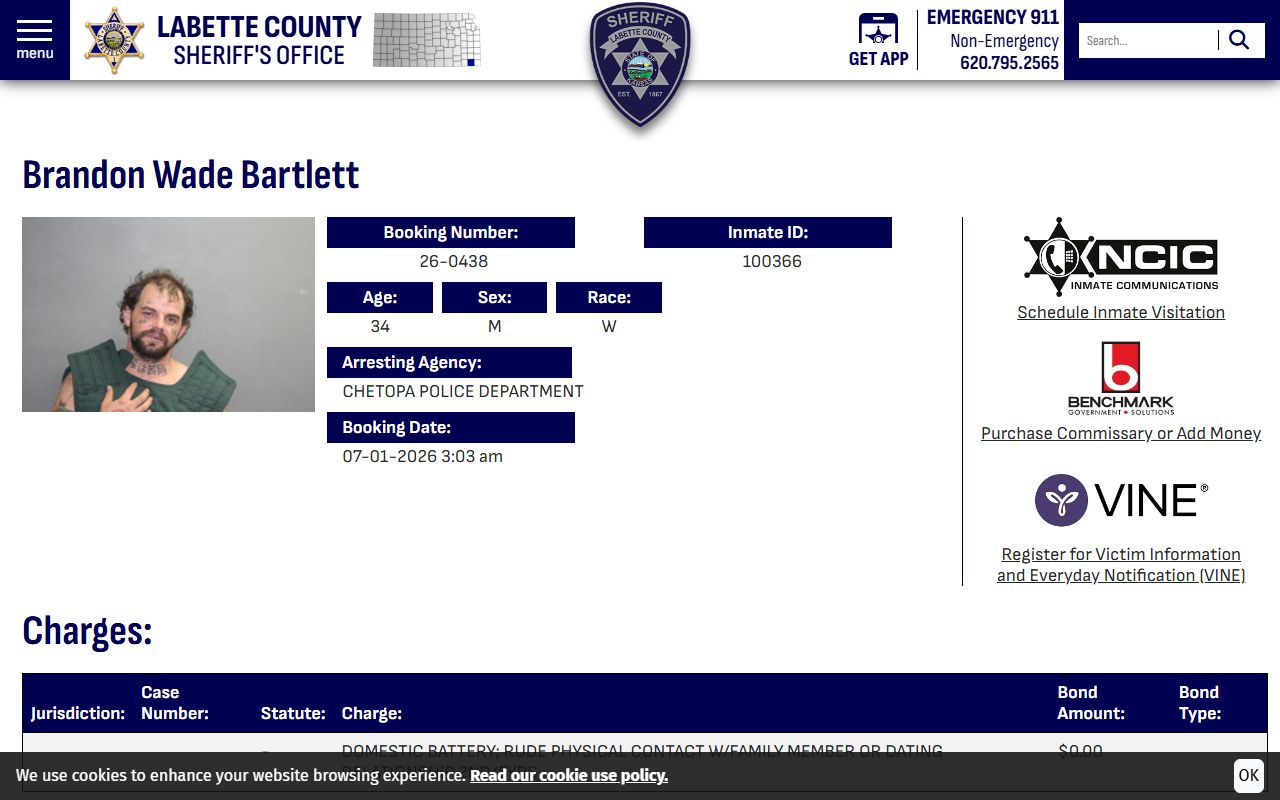
That profile format is useful because it places booking number, inmate ID, arresting agency, charge text, bond, and service links near one another, but it is still a jail profile rather than a certified court record.
Find Labette County Arrest Records
Use a channel chain for Labette County arrest records. Start with the Sheriff's current inmate roster for active custody, use the Parsons Police lockup roster for city detention, then move to Kansas Case Search when the charge has become a District Court case. Municipal charges may stay with city court. Parsons Municipal Court handles misdemeanors and traffic citations inside Parsons, while sheriff warrant research also names Altamont, Chetopa, Edna, Mound Valley, and Oswego municipal courts as local warrant-issuing courts.
- Search the sheriff roster by current or released status when the person may be in Labette County Jail.
- Check whether the roster profile lists a case number, statute, bond amount, or charge text.
- Search Kansas Case Search by case number, party name, citation, or other public criteria if the matter is in District Court.
- Contact the Clerk of the District Court if online results are incomplete or if a copy is needed.
- Use municipal court channels when the charge arose from a city misdemeanor or city traffic matter.
The sheriff records page is also part of the access path for law-enforcement records that are not posted online. Kansas court guidance says District Court records requests must be in writing and that the court must act by the end of the third business day after receiving the request. County open-record requests for non-court county records use the Labette County Open Records process.
The Labette County KS Sheriff app can also support arrest-to-charge research through mobile access to the inmate roster, enhanced inmate profiles, Most Wanted, offender search, crime tips, press releases, and sheriff contact tools. The official release does not make charge data app-only, so the app is best used with the website roster, Kansas Case Search, and court or sheriff confirmation.
Labette County Charges After Arrest
Charges after arrest move from allegation to court record through a filing decision. Labette County uses a County Attorney rather than a District Attorney title. The County Attorney prosecutes Kansas criminal-law violations, juvenile offender matters, abused or neglected child cases, and certain commitment proceedings. The office is listed with a Parsons office at 201 S. Central Avenue and an Oswego office at 417 Merchant Street. That office is the key public actor between the jail booking entry and the court case file.
| Document | Who Files It | How It Works in Labette County |
|---|---|---|
| Complaint | Prosecutor or authorized filer | Common charging or initiating paper for Kansas criminal cases and municipal matters. |
| Information | Prosecutor | Formal criminal charging document used after the prosecutor decides which counts to pursue. |
| Indictment | Grand jury | Less common, but it can be used when a grand jury returns charges. |
A single arrest can lead to no filed charge, one filed charge, or several counts. The jail profile may list initial charge text, while the District Court or municipal court record shows the filed count, court case number, hearings, orders, and disposition. That is why Labette County court charges after arrest should be checked in both the booking source and the court source when accuracy matters.
Labette County Court Charge Fields
The official research captured a useful charge-field inventory from the sheriff inmate profile. It can show more than a simple charge label. The profile may include jurisdiction, case number, statute, charge, bond amount, and bond type. Some columns can be blank, and the sheriff roster warns that charges and bail amounts may change after court appearances. Bond companies and people posting bail are told to contact jail staff at 620-795-2565 for correct bail amount, charges, and case numbers.
The Labette County Sheriff's records page identifies the records function that supports this flow.
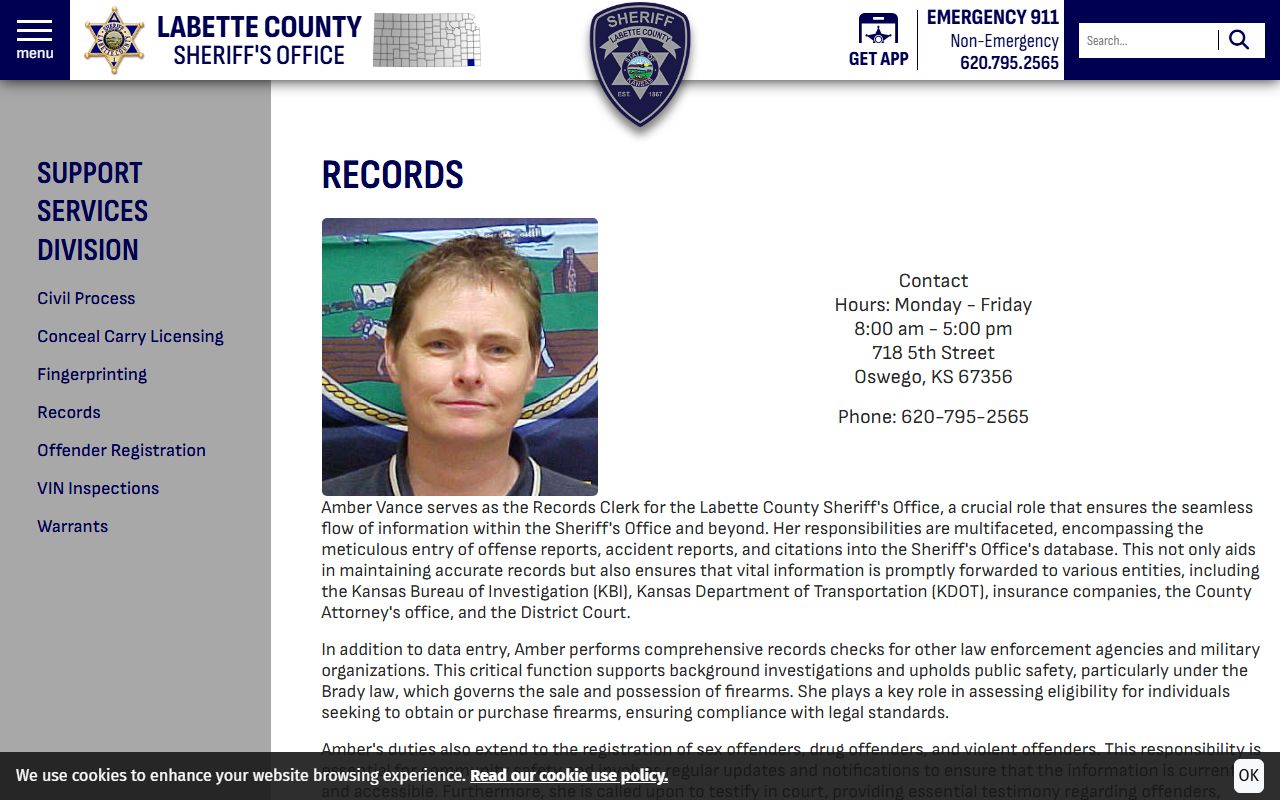
Because the sheriff records office forwards information to the County Attorney and District Court, it is a practical starting point for non-court reports while the filed court charge remains with the court.
| Field | What It Means |
|---|---|
| Jurisdiction | The court or agency context for the listed charge when the profile provides it. |
| Case Number | The case identifier that can connect booking information to Kansas Case Search or court staff. |
| Statute | The Kansas or local law section tied to the charge, when shown. |
| Charge | The public charge label, which may later be amended, reduced, or dismissed. |
| Bond Amount and Type | The posted release condition, if set, subject to change after court review. |
Labette County Charge Status
Charge status is not fixed at booking. A prosecutor may file a different count from the arrest label, amend the count after review, reduce it through plea talks, dismiss it, or proceed to conviction. Kansas District Court records can show status terms such as open, pending, disposed, closed, dismissed, sealed, inactive, transferred, and events tied to pleas, orders, sentencing, and warrants. Municipal cases can have their own court workflow for city-level misdemeanors and traffic charges.
| Status | Plain Meaning | Where to Check |
|---|---|---|
| Pending | The charge has not reached final disposition. | Kansas Case Search, courthouse terminal, or issuing municipal court. |
| Amended or Reduced | The filed count changed from its earlier wording or severity. | District Court docket entries and prosecutor filings. |
| Dismissed | The court record shows the charge did not proceed to conviction. | Case disposition and journal entries. |
| Disposed or Closed | The court has entered a final result or closed the case. | District Court case status and clerk copies. |
Note: A jail roster charge label is a lead, not proof of final guilt or final court status.
Labette County Charges vs Convictions
A charge is an accusation filed or listed in a case. A conviction is a final result after a guilty plea, no contest plea accepted by the court, or guilty verdict. Labette County arrest records may show charges for a person who is later not convicted. The criminal case file can also show charges that were dropped, dismissed, changed, or resolved through diversion. Diversion is an agreement that may avoid conviction if conditions are completed.
| Point | Charge | Conviction |
|---|---|---|
| Role | An accusation or count filed after review. | The final court finding or accepted plea. |
| Timing | Early or middle stage of the case. | Near the end of the case. |
| Record location | Jail profile, District Court, or municipal case record. | Court disposition, judgment, and sentence records. |
| Risk in background use | Can be mistaken for guilt if read alone. | Still must be verified with the source court. |
Statewide Charge and History Checks
Statewide systems answer different questions from Labette County arrest records. The Kansas criminal history record search is the official KBI/Kansas.gov process for public criminal-history checks, but it is not a live jail roster and it does not replace the court case file. KBI registered offender search is a separate public registry for sex, violent, and drug offender registration data. KDOC KASPER is for sentenced state-prison custody, not a county booking record.
For arrest-to-charge work, use the state systems as confirmation sources rather than substitutes. Kansas Case Search remains the main District Court case search route. The courthouse terminal and a written request to the Clerk of the District Court are the fallback when public online data is missing, older, sealed, or document-limited.
Restricted Labette County Arrest Records
Kansas public policy under K.S.A. 45-216 favors public inspection of open records unless another law closes them. K.S.A. 45-220 sets request procedures, and Kansas court rules govern public electronic court access. That access does not make every arrest, charge, or case detail public. Juvenile and child-in-need-of-care materials are more limited, adoption records are usually restricted, sealed cases do not appear like open cases, and protected identifiers should be redacted.
K.S.A. 21-6614 is the Kansas expungement statute for eligible convictions, arrest records, and diversion agreements.
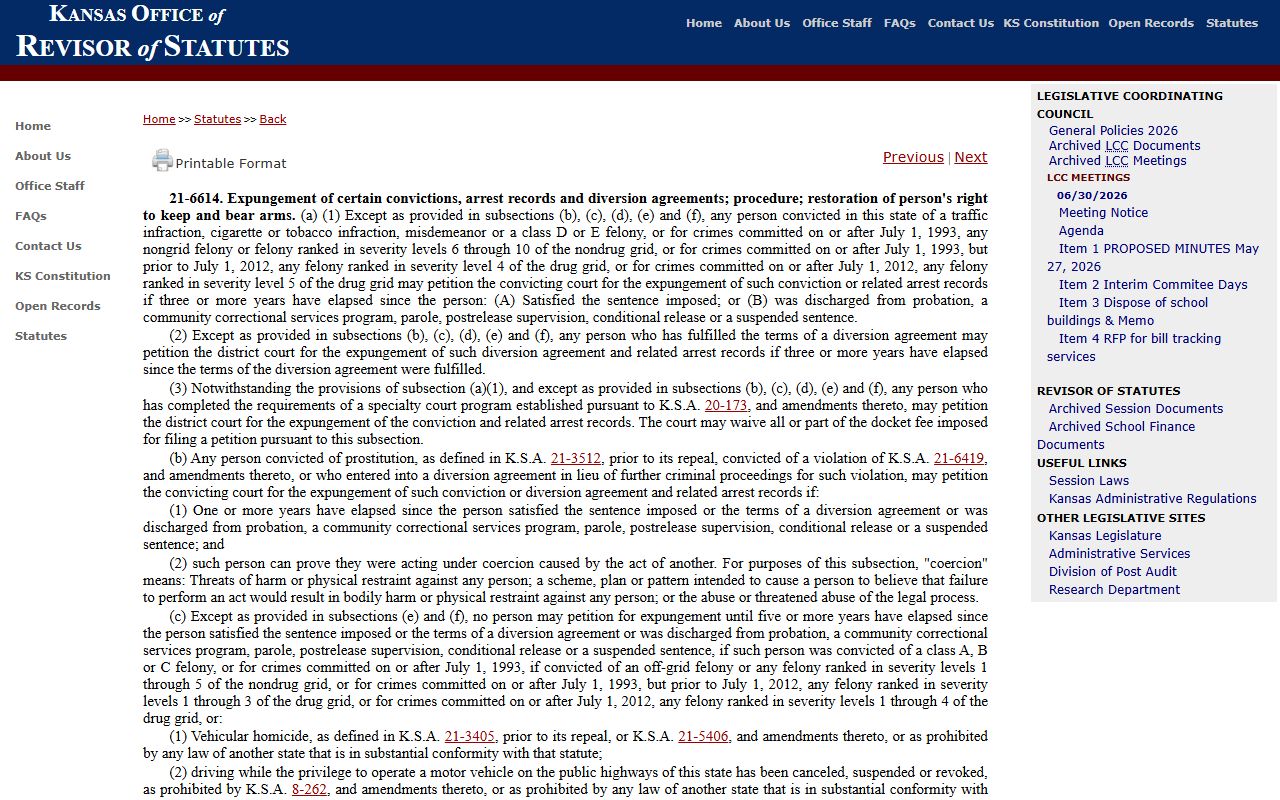
Expungement can limit public access, but it does not mean every agency use is erased for every purpose, so eligibility and effect must be checked in the court where the case occurred.
| Access Limit | Effect on Public Search | Practical Route |
|---|---|---|
| Sealed record | Hidden from public search by statute or court order. | Ask the source court about lawful access. |
| Expunged record | Public access may be limited for eligible arrests, convictions, or diversion records. | Use the expungement case order and court file. |
| Juvenile record | Many juvenile materials are not public like adult cases. | Use court-approved access only. |
| Active investigation | Some law-enforcement records may be withheld or redacted. | Submit a records request and expect custodian review. |